Why Reliable Drilling Rig Gearboxes Make All the Difference in Heavy-Duty Drilling
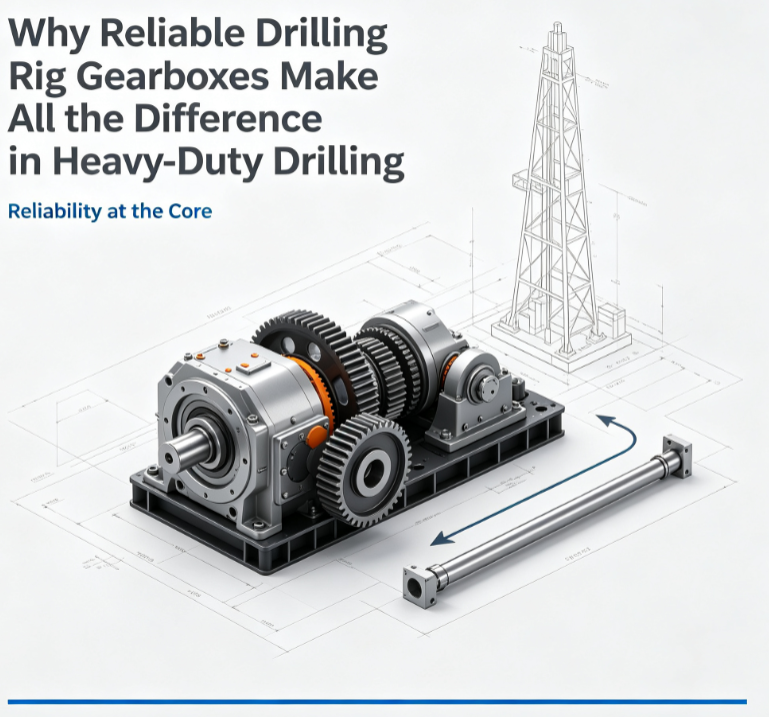
Heavy-Duty Drilling Doesn't Forgive Weak Gearboxes
Anyone who's spent time around a drilling site knows one simple truth: the gearbox rarely gets the spotlight—until it fails.
When a drilling rig stops because of gearbox problems, the consequences go far beyond replacing a damaged component. Lost drilling hours, idle crews, delayed project schedules, and expensive equipment downtime can quickly outweigh the cost of the gearbox itself. In offshore oil fields or remote mining sites, even a single day of unplanned shutdown can translate into tens of thousands of dollars in operational losses.
That's why experienced drilling contractors don't look at Drilling Rig Gearboxes as ordinary transmission components. They see them as the mechanical heart of the entire drilling system.
Modern drilling operations demand more than raw torque. Equipment must withstand continuous shock loads, variable speeds, abrasive environments, and long operating cycles while maintaining precise power transmission. Whether the application involves oil and gas exploration, geothermal drilling, water well construction, mining, or foundation engineering, gearbox reliability directly influences productivity, maintenance costs, and equipment lifespan.
According to the International Energy Agency (IEA), global energy demand continues to increase alongside investments in oil, natural gas, geothermal, and critical mineral exploration. At the same time, industries are pushing drilling equipment to operate longer with fewer maintenance interruptions. That trend places unprecedented demands on heavy-duty gearboxes, lubrication systems, bearing technology, and precision gear manufacturing.
Simply put, a reliable gearbox is no longer just a mechanical component—it is an investment in operational continuity.
Table of Contents
· Why Drilling Rig Gearboxes Matter More Than Ever
· What Is a Drilling Rig Gearbox?
· How a Drilling Rig Gearbox Works
· Common Types of Drilling Rig Gearboxes
· Key Components Inside a Heavy-Duty Gearbox
· Why Gearbox Reliability Determines Drilling Performance
· Engineering Factors That Affect Gearbox Selection
· Performance Comparison of Modern Drilling Rig Gearboxes
Why Drilling Rig Gearboxes Matter More Than Ever
Drilling projects have become more demanding over the last decade.
Today's rigs drill deeper wells, encounter more complex geological formations, and operate in environments ranging from Arctic oil fields to high-temperature geothermal sites. At the same time, contractors are expected to reduce fuel consumption, shorten drilling cycles, and improve equipment availability.
These changing requirements have shifted greater responsibility onto the drilling transmission system.
A high-quality Drilling Rig Gearbox performs several essential functions simultaneously:
· Transmits engine or motor power efficiently
· Converts speed into usable drilling torque
· Maintains smooth power delivery under fluctuating loads
· Absorbs shock loads generated during drilling
· Protects downstream drivetrain components
· Supports continuous operation under harsh working conditions
If any of these functions become unstable, drilling efficiency declines almost immediately.
That's one reason gearbox manufacturers now focus not only on strength, but also on thermal management, gear accuracy, bearing life, sealing technology, and predictive maintenance.
What Is a Drilling Rig Gearbox?
A Drilling Rig Gearbox is a specialized industrial gearbox designed to transfer and multiply power between the prime mover—typically a diesel engine or electric motor—and the drilling equipment.
Unlike general industrial gearboxes, drilling gearboxes operate under highly variable torque conditions.
They must withstand:
· Continuous heavy loads
· Frequent impact loading
· High starting torque
· Sudden direction changes
· Long-duty operating cycles
· Severe environmental contamination
To achieve this, manufacturers often combine hardened alloy steel gears, heavy-duty bearings, reinforced housings, and advanced lubrication systems into one integrated power transmission unit.
Depending on the drilling method, a gearbox may drive:
· Rotary tables
· Top drives
· Mud pumps
· Winches
· Hoisting systems
· Feed mechanisms
· Rotary heads
Because every drilling application has different torque and speed requirements, custom drilling rig gearboxes are common across the industry.
How a Drilling Rig Gearbox Works
Although gearbox configurations vary between drilling rigs, their operating principle remains relatively straightforward.
Step 1: Power Input
Power originates from a diesel engine, hydraulic motor, or electric motor.
The gearbox receives rotational energy through the input shaft.
Step 2: Gear Reduction
Inside the housing, multiple gear stages reduce rotational speed while increasing output torque.
Depending on drilling requirements, the gearbox may contain:
· Helical gears
· Planetary gears
· Spur gears
· Bevel gears
· Combination gear trains
Each design balances efficiency, torque capacity, and durability differently.
Step 3: Torque Transmission
The amplified torque transfers to the drilling equipment.
Stable torque delivery helps maintain drilling speed even when geological resistance changes dramatically.
This becomes especially important when drilling through mixed rock formations.
Step 4: Continuous Lubrication
Throughout operation, lubrication systems distribute oil across gears and bearings.
The lubricant performs several critical functions:
· Reduces friction
· Removes heat
· Prevents metal-to-metal contact
· Minimizes wear
· Protects against corrosion
Without effective lubrication, gearbox life decreases rapidly.
Common Types of Drilling Rig Gearboxes
No single gearbox design fits every drilling project.
Engineers select gearbox configurations based on drilling depth, torque requirements, available installation space, and operating environment.
Planetary Gearboxes
Planetary gearboxes have become increasingly popular for modern drilling rigs.
Their compact structure offers:
· High torque density
· Excellent load distribution
· High transmission efficiency
· Compact installation size
These advantages make them suitable for top drives and rotary drilling systems.
Helical Gearboxes
Helical gearboxes provide smooth and quiet power transmission.
Because multiple teeth remain engaged simultaneously, they offer:
· Reduced vibration
· Higher efficiency
· Lower operating noise
· Longer service life
Many industrial gearbox manufacturers adopt helical gear designs for continuous-duty drilling equipment.
Bevel-Helical Gearboxes
When power must change direction, bevel-helical combinations provide an effective solution.
They are frequently used in drilling rigs with complex drivetrain layouts.
Multi-Stage Reduction Gearboxes
Large drilling rigs often require extremely high torque outputs.
Multi-stage reduction systems allow engineers to achieve substantial speed reduction while maintaining mechanical efficiency.
These gearboxes are common in deep drilling, mining exploration, and offshore applications.
Key Components Inside a Heavy-Duty Gearbox
A reliable Drilling Rig Gearbox is much more than a set of gears inside a housing.
Every component contributes to long-term durability.
Gear Sets
Gear quality directly determines transmission performance.
Most premium gearboxes use:
· Case-hardened alloy steel
· Precision grinding
· Optimized tooth profiles
· Surface finishing technologies
High gear accuracy minimizes vibration while improving efficiency.
Bearings
Bearings support rotating shafts while absorbing radial and axial loads.
Because drilling equipment experiences continuous shock loading, manufacturers often specify heavy-duty roller bearings with extended fatigue life.
Bearing selection influences:
· Gear alignment
· Heat generation
· Operating noise
· Overall gearbox lifespan
Shafts
Input and output shafts transmit torque throughout the drivetrain.
Proper shaft design requires balancing:
· Torsional strength
· Fatigue resistance
· Dimensional accuracy
· Material toughness
Finite Element Analysis (FEA) is now widely used during shaft development.
Housing
The gearbox housing protects internal components from contamination while maintaining alignment.
Modern housings are typically manufactured from:
· High-strength cast iron
· Ductile iron
· Cast steel
· Welded steel structures
Structural rigidity becomes increasingly important as gearbox torque increases.
Sealing System
Dust, drilling mud, water, and abrasive particles present constant challenges.
Advanced sealing systems help prevent lubricant leakage while blocking contaminants from entering the gearbox.
Improved sealing technology often extends maintenance intervals significantly.
Why Reliable Gearboxes Improve Heavy-Duty Drilling
When discussing gearbox performance, engineers usually focus on more than power transmission.
Reliability affects nearly every aspect of drilling operations.
Higher Operational Availability
Equipment that remains operational longer generates more productive drilling hours.
Reliable heavy-duty gearboxes reduce unexpected shutdowns while improving project scheduling.
Improved Torque Stability
Consistent torque output allows drilling tools to cut more efficiently through changing geological formations.
Stable power transmission also reduces stress on downstream equipment.
Lower Maintenance Costs
Well-designed gearboxes require fewer emergency repairs.
Predictable maintenance schedules allow operators to plan servicing instead of reacting to failures.
This lowers total ownership costs over the equipment's lifecycle.
Longer Equipment Life
Gearboxes that minimize vibration and shock loading also reduce wear on connected components, including motors, couplings, shafts, and drilling tools.
The result is a more reliable drilling system as a whole.
Engineering Factors Before Selecting a Drilling Rig Gearbox
Choosing the right gearbox involves much more than matching horsepower ratings.
Engineers typically evaluate several critical factors before making a purchasing decision.
Torque Requirements
Maximum continuous torque often determines gearbox size more than motor power alone.
Peak torque generated during difficult drilling conditions should also be considered.
Operating Environment
Drilling environments differ dramatically.
Applications may involve:
· Desert heat
· Arctic temperatures
· Offshore saltwater exposure
· Underground mining dust
· High-humidity tropical regions
Environmental conditions influence material selection, sealing technology, and lubrication requirements.
Duty Cycle
Some rigs operate intermittently.
Others run almost continuously for weeks.
Understanding expected operating hours helps determine appropriate bearing life, cooling capacity, and maintenance intervals.
Typical Performance Characteristics of Modern Drilling Rig Gearboxes
Performance Factor | Industrial Benefit |
Torque Capacity | Supports demanding drilling operations |
Transmission Efficiency | Reduces energy losses |
Shock Load Resistance | Improves equipment durability |
Gear Accuracy | Minimizes vibration and noise |
Lubrication Performance | Extends gear and bearing life |
Service Life | Lowers lifecycle operating costs |
Maintenance Accessibility | Reduces downtime during servicing |
Looking at these performance factors together, one conclusion becomes obvious.
A Drilling Rig Gearbox is far more than a mechanical transmission. It is one of the key systems that determines drilling efficiency, operational reliability, maintenance costs, and long-term equipment performance.
Materials, Maintenance, and Choosing the Right Drilling Rig Gearbox
A Drilling Rig Gearbox doesn't earn its reputation in the factory. It earns it on the job site.
Out in the field, there's no controlled environment. Dust works its way into every opening, temperatures fluctuate dramatically, drilling loads change without warning, and operators expect the gearbox to keep transmitting power hour after hour. That's why manufacturers increasingly evaluate gearboxes by their entire lifecycle rather than their catalog specifications alone.
For buyers, understanding what happens inside the gearbox after thousands of operating hours is just as important as understanding its torque rating.
Material Selection Makes a Bigger Difference Than Many Buyers Expect
When people compare gearboxes, they often focus on torque capacity or gear ratios. Those specifications matter, of course. But material selection frequently determines whether a gearbox lasts five years—or fifteen.
Every major component experiences different stresses, which is why manufacturers rarely use a single material throughout the assembly.
Gear Materials
The gears carry the highest contact stresses inside the transmission.
Premium drilling gearbox manufacturers generally use alloy steels such as:
· 20CrMnTi
· 18CrNiMo7-6
· 17CrNiMo6
· AISI 8620
These steels typically undergo carburizing, quenching, and precision grinding to produce:
· High surface hardness
· Excellent fatigue strength
· Strong wear resistance
· Stable tooth geometry
Surface hardness often reaches 58–62 HRC, while the core remains tough enough to absorb impact loads.
Shaft Materials
Shafts continuously transmit torsional loads throughout the drilling process.
Typical materials include:
· 42CrMo
· AISI 4140
· AISI 4340
These materials provide an excellent balance between strength, toughness, and machinability.
Large rotary drilling systems may also incorporate induction hardening on bearing journals to improve wear resistance.
Housing Materials
The gearbox housing is more than a protective shell.
Its rigidity directly affects gear alignment.
Common housing materials include:
· High-strength gray cast iron
· Ductile iron
· Cast steel
· Welded steel fabrications
For extremely high-power drilling equipment, welded steel housings often provide greater structural strength while reducing deformation under heavy loads.
Heat Treatment Determines Gear Life
Even the highest-quality steel performs poorly without proper heat treatment.
Professional industrial gearbox manufacturers invest heavily in controlled heat treatment because gear durability depends on it.
Common processes include:
Carburizing
Creates a hard wear-resistant outer layer while maintaining a tough core.
Ideal for gears subjected to continuous rolling contact.
Quenching and Tempering
Improves overall strength and fatigue resistance.
Widely used for shafts and heavily loaded transmission components.
Precision Gear Grinding
After heat treatment, gear teeth are ground to improve:
· Tooth profile accuracy
· Surface finish
· Noise performance
· Transmission efficiency
According to the American Gear Manufacturers Association (AGMA), higher gear accuracy contributes to smoother load distribution and reduced vibration during operation.
Lubrication Is More Than Just Oil
Many gearbox failures aren't caused by broken gears.
They're caused by lubrication problems.
An effective lubrication system performs several essential tasks simultaneously:
· Reduces friction
· Carries away heat
· Prevents corrosion
· Removes wear particles
· Protects bearing surfaces
Poor lubrication shortens component life long before visible damage appears.
Common Lubrication Systems
Different drilling applications require different lubrication methods.
Splash Lubrication
Suitable for medium-speed gearboxes.
Rotating gears distribute lubricant throughout the housing.
Advantages include:
· Simple structure
· Low maintenance
· Lower manufacturing cost
Forced Circulation Lubrication
Large heavy-duty gearboxes frequently use oil pumps.
Pressurized oil reaches every bearing and gear mesh regardless of rotational speed.
Additional oil coolers often help maintain stable operating temperatures.
Oil Condition Monitoring
Modern drilling equipment increasingly incorporates:
· Oil temperature sensors
· Pressure sensors
· Particle counters
· Oil quality monitoring systems
These technologies support predictive maintenance and reduce unexpected gearbox failures.
Common Failure Modes and Their Causes
Even well-designed Drilling Rig Gearboxes eventually experience wear.
Understanding common failure mechanisms helps operators prevent expensive repairs.
Failure Mode | Typical Cause | Preventive Action |
Gear Tooth Pitting | Surface fatigue | Improve lubrication quality |
Scuffing | High temperature and poor lubrication | Monitor oil temperature |
Bearing Failure | Contamination or overload | Regular oil analysis |
Shaft Fatigue | Excessive torsional loading | Proper gearbox sizing |
Seal Leakage | Seal wear or contamination | Scheduled seal replacement |
Excessive Noise | Gear misalignment or wear | Precision installation and inspection |
Preventive maintenance almost always costs less than emergency repairs.
Maintenance Strategies That Extend Gearbox Life
Routine maintenance isn't particularly exciting.
Still, experienced drilling contractors know it's one of the highest-return investments they can make.
A practical maintenance program should include:
Daily Inspection
· Check oil level
· Inspect for leaks
· Listen for unusual noise
· Monitor operating temperature
Monthly Inspection
· Examine shaft seals
· Inspect mounting bolts
· Check bearing vibration
· Review operating records
Scheduled Oil Analysis
Oil analysis reveals problems long before mechanical failure becomes visible.
Laboratories can identify:
· Metal wear particles
· Water contamination
· Oxidation
· Viscosity changes
According to maintenance guidance published by major bearing manufacturers, condition monitoring significantly improves equipment reliability in heavy industrial applications.
How to Evaluate a Drilling Rig Gearbox Supplier
Choosing the right supplier involves much more than comparing prices.
A qualified supplier should demonstrate expertise in engineering, manufacturing, and long-term technical support.
Consider several factors during supplier evaluation.
Engineering Capability
Reliable manufacturers provide:
· Gear calculations
· Finite Element Analysis (FEA)
· Gear contact analysis
· Load simulations
· Customized transmission solutions
Strong engineering support often reduces project risks before manufacturing begins.
Manufacturing Equipment
Precision gear production requires advanced equipment such as:
· CNC gear hobbing machines
· Gear grinding machines
· Coordinate Measuring Machines (CMM)
· Gear inspection systems
· Dynamic balancing equipment
Production capability directly affects gearbox quality.
Quality Control
Look for manufacturers certified under internationally recognized standards such as:
· ISO 9001
· ISO 14001
· ISO 45001
Some suppliers also perform:
· Full-load testing
· Noise testing
· Efficiency testing
· Leakage testing
· Endurance testing
These inspections provide greater confidence before shipment.
Industry Case Study: Bonfiglioli Gearboxes in Heavy-Duty Drilling Equipment
One well-known example comes from Bonfiglioli, an international manufacturer of industrial gearboxes and planetary drives.
Its heavy-duty planetary gearbox solutions are widely used in drilling rigs, foundation engineering equipment, mining machinery, and construction applications.
In several published customer projects, Bonfiglioli planetary gearboxes have been selected because they combine high torque density with compact dimensions, allowing drilling equipment manufacturers to reduce drivetrain size while maintaining reliable torque transmission under demanding operating conditions.
The case illustrates an important point.
For modern drilling systems, gearbox selection affects not only power transmission but also equipment layout, maintenance planning, fuel efficiency, and long-term operating costs.
Sources: Bonfiglioli Technical Documentation; AGMA publications.
Future Trends in Drilling Rig Gearboxes
The drilling industry continues to evolve, and gearbox technology is evolving alongside it.
Several trends are shaping the next generation of drilling transmission systems.
Higher Torque Density
Manufacturers continue increasing torque capacity without significantly increasing gearbox size.
Intelligent Condition Monitoring
Integrated sensors now provide real-time monitoring of:
· Temperature
· Vibration
· Oil quality
· Bearing condition
· Operating hours
These systems support predictive maintenance rather than reactive repairs.
Improved Surface Engineering
Advanced coatings and finishing technologies continue improving gear durability while reducing friction losses.
Digital Design and Simulation
Finite Element Analysis (FEA), Computational Fluid Dynamics (CFD), and digital twins allow engineers to optimize gearbox performance before production begins.
Frequently Asked Questions
How long should a drilling rig gearbox last?
Service life depends on operating conditions, maintenance practices, and gearbox quality. With proper lubrication and preventive maintenance, industrial drilling gearboxes can operate reliably for many years before requiring major overhaul.
Which gearbox type is most suitable for heavy-duty drilling?
Planetary gearboxes are widely preferred because they provide high torque density, compact size, and excellent load-sharing characteristics. However, the best choice depends on the specific drilling application and transmission requirements.
How often should gearbox oil be replaced?
Oil change intervals vary according to operating hours, temperature, load, and lubricant type. Most manufacturers recommend following maintenance schedules supported by periodic oil analysis rather than relying solely on fixed time intervals.
What is the biggest mistake when purchasing a drilling rig gearbox?
Focusing only on purchase price.
A gearbox should be evaluated based on total lifecycle cost, including efficiency, maintenance requirements, service life, spare parts availability, and technical support.
Final Thoughts
A reliable Drilling Rig Gearbox does far more than transfer power from the engine to the drill string.
It stabilizes torque, absorbs shock loads, protects critical drivetrain components, and supports continuous drilling under some of the harshest operating conditions found in modern industry.
As drilling projects become deeper, more automated, and more technically demanding, gearbox performance increasingly influences productivity, operating costs, and equipment reliability. Choosing the right gearbox therefore means evaluating engineering design, material quality, manufacturing capability, lubrication systems, and supplier expertise—not simply comparing specifications on a data sheet.
If you're planning a new drilling project or upgrading existing equipment, investing time in selecting the right Drilling Rig Gearbox can pay dividends throughout the entire service life of the machine.
For more detailed technical specifications or customized gearbox solutions, consult an experienced gearbox manufacturer that can provide engineering support tailored to your drilling conditions.